Software Will Compete on Price. And Taste

2026-11-12 10:42:59 UTC
For a long time, building great software required great engineers.
If you wanted to build something like Zoom, you needed engineers who understood video streaming, networking, latency, infrastructure, and a hundred other complicated things. These engineers were hard to find, expensive to hire, and even harder to retain.
Not every company could afford them.
This created a natural separation in the software industry. Companies with exceptional engineering teams could build things that others couldn't. They could charge a premium because replicating their software was genuinely difficult.
I think AI is fundamentally changing this equation.
Today, every software company has access to increasingly capable AI models.
The biggest technology companies use them. Small startups use them. Independent developers use them. Even people who have never written software before are building applications with AI.
Of course, the models aren't perfect. They make mistakes, and experienced engineers are still needed to solve difficult problems.
But the direction is clear.
Engineering knowledge that once took years to acquire is becoming available to anyone willing to pay for tokens.
A small team with access to capable AI models can now build software that would previously have required a much larger engineering organization.
And the same models are available to competitors.
This is the important part.
If Company A can build a feature using AI, there's a good chance Company B can build something similar using the same tools.
The engineering advantage that once separated companies is becoming smaller.
Historically, software companies have enjoyed extraordinary margins.
Once software was built, selling it to another thousand customers cost relatively little. But building that software in the first place required significant investment.
AI is dramatically reducing that initial investment.
Features that once required weeks of engineering work can sometimes be built in days or hours.
As the cost of building software falls, more competitors can enter the market.
The important change isn't simply that software is cheaper to build. It's that competitors can respond much faster.
I expect this to put significant downward pressure on software prices, particularly in categories where products are relatively easy to replicate and switching costs are low.
If everyone can build similar features, how do software companies differentiate themselves?
I think taste becomes increasingly important.
Consider project management software.
Basecamp, Asana, and ClickUp all help teams manage projects. Yet they approach the problem very differently.
Basecamp believes in simplicity and a relatively opinionated way of working.
Asana emphasizes structured work management and coordination across teams.
ClickUp takes a more expansive approach, offering extensive functionality and customization.
These differences aren't primarily about which company has engineers capable of building a task management system.
They're about how each company believes work should be organized.
That's taste.
Taste determines which features to build, which features to leave out, how complicated a workflow should be, and how the product should feel.
AI can help implement these decisions. But deciding what should exist in the first place remains a different problem.
As engineering capabilities become more widely available, I expect these product decisions to matter more.
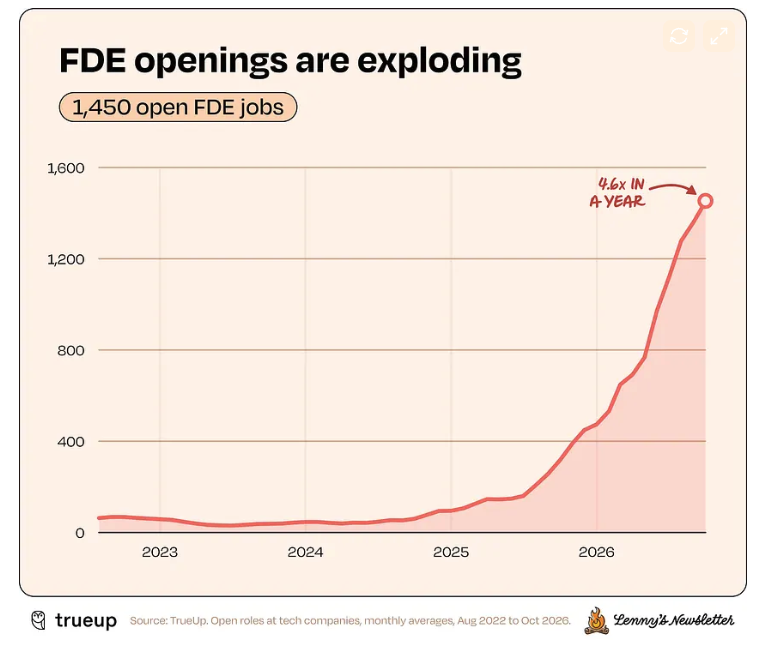
We're already seeing interesting changes in hiring. Forward-deployed engineer (FDE) openings are exploding.
According to TrueUp data shared in Lenny's Newsletter, open FDE positions at tech companies increased 4.6 times in a year, reaching approximately 1,450 by October 2026.
I don't think this is a coincidence.
Traditionally, software companies hired engineers to build features. Product managers decided what needed to be built. Designers figured out how it should look and work. Engineers implemented those requirements, and other engineers deployed and maintained the software.
AI is changing this division of labor.
I think companies will increasingly want people who can talk to customers, understand their problems, figure out what needs to be built, and then build and deploy the solution themselves.
That's the kind of end-to-end ownership that makes forward-deployed engineers interesting.
Companies may need fewer people whose primary contribution is writing code or coordinating work between teams, and more people who can understand customer problems, make good decisions, use AI effectively, and take responsibility for the outcome.
The rapid growth in FDE openings is an early signal of this shift, even if it doesn't yet prove that traditional roles are being replaced.
I expect smaller teams, fewer handoffs, and more people who can take a customer problem all the way to production.
There are important exceptions to this argument.
Building a video calling application is becoming easier. Running a service like Zoom reliably for millions of users is still enormously difficult.
The same applies to products that require sophisticated infrastructure, regulatory compliance, security, or complex integrations.
And established companies have advantages beyond engineering.
They have customers, brands, distribution channels, proprietary data, and years of accumulated trust.
AI doesn't automatically erase any of these advantages.
But I do think it weakens one particular advantage: the ability to charge a premium simply because building the software is difficult.
That advantage is becoming less durable.
For decades, one of the biggest questions in software was: Can we build it?
Increasingly, the answer will be yes.
The more interesting questions will be:
Should we build it? What should we leave out? How should it work? How much should it cost?
AI is making engineering capability more accessible, and I think that will fundamentally change competition in the software industry.
There will always be exceptions. Some companies will retain strong advantages through infrastructure, distribution, ecosystems, or proprietary data.
But for a large portion of the software market, I expect the ability to build features to become less valuable as a competitive advantage.
When everyone can build, building itself stops being special.
Software will increasingly compete on price and taste.
And I suspect price will matter more than many software companies are prepared for.
